
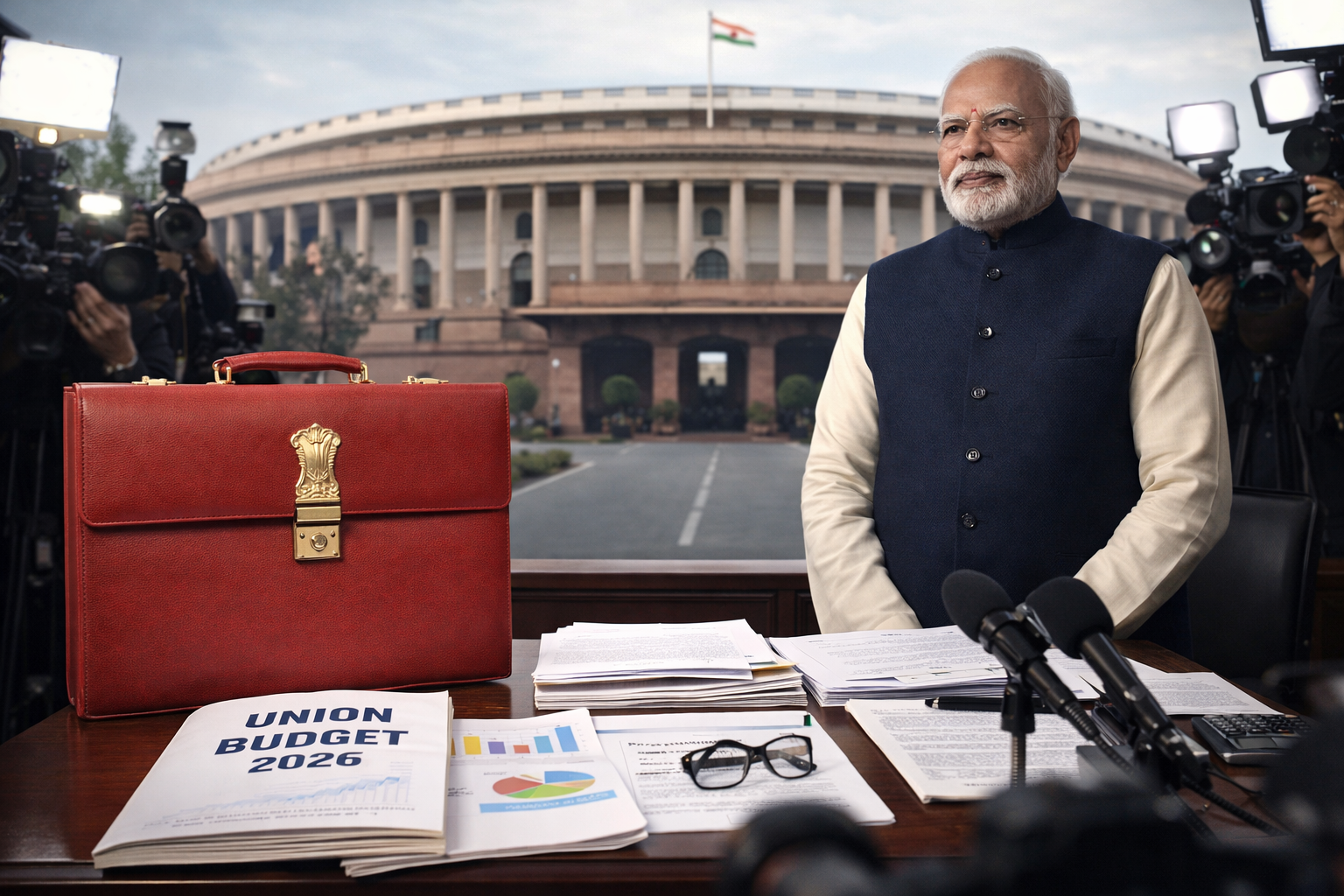
India Union Budget 2026–27: A Complete Guide:
The Indian Union Budget 2026–27, presented on 1 February 2026, focuses on sustained economic growth, infrastructure investment, and fiscal discipline amid global challenges. It boosts public capital expenditure, supports manufacturing and MSMEs, and promotes ease of doing business with targeted reforms. The budget also introduces incentives for sectors like semiconductor and bio-pharma manufacturing while emphasizing inclusive growth through rural development and social welfare measures. Overall, it aims to balance long-term development with macroeconomic stability for India’s future.

📊 1. Macro Overview & Fiscal Strategy
The Union Budget emphasizes fiscal sustainability while boosting investment-led growth:
-
Fiscal deficit for FY 2026–27 targeted at around 4.3 % of GDP, continuing the medium-term consolidation roadmap.
-
Net market borrowings planned at about ₹11.7 lakh crore to support productive expenditure.
-
A continued focus on managing debt-to-GDP ratios and strengthening economic stability.
🛠️ 2. Infrastructure and Connectivity Boost
Infrastructure remains the engine of growth:
🏗️ Capital Expenditure
-
Public capital expenditure soared to ₹12.2 lakh crore, one of the highest allocations, driving long-term economic activity.
🚆 High-Speed Rail & Logistics
-
Seven new high-speed rail corridors announced connecting major cities to promote faster, cleaner mobility.
-
A new Dedicated Freight Corridor between Dankuni (East) and Surat (West) enhances logistics and supply chain efficiency.
-
20 national waterways to be operationalized over five years, boosting inland and coastal cargo movement.
🌊 Coastal & Urban Connectivity
-
A Coastal Cargo Promotion Scheme aims to expand shipping’s share of logistics from ~6 % to 12 % by 2047.
-
City Economic Regions (CERs) to receive ₹5,000 crore over five years for urban infrastructure uplift.
🏭 3. Manufacturing & Strategic Sector Growth
To accelerate India’s global competitiveness:
🔬 High-Tech & Strategic Initiatives
-
India Semiconductor Mission (ISM) 2.0 launched to strengthen semiconductor design, equipment, and manufacturing.
-
Biopharma SHAKTI Mission with ₹10,000 crore over five years to make India a global biopharma hub.
-
Electronics Components Manufacturing Scheme expanded to ₹40,000 crore.
-
Rare Earth Corridors to support mineral-rich states in mining and manufacturing of critical materials.
🧵 Traditional & Emerging Sectors
-
Mega textile parks, National Fibre Scheme, and support for khadi & handicrafts aim to modernise legacy industries.
-
A scheme to revive 200 legacy industrial clusters will improve competitiveness and jobs.
💼 4. Tax & Compliance Reforms
The 2026 budget introduces meaningful changes to the tax framework:
📉 Easing Compliance
-
Simplified income tax rules and redesigned ITR forms to make filing easier.
-
Motor accident compensation interest made fully tax-free, with TDS removed.
-
TCS on foreign education, travel, and medical remittances reduced to 2 %, reducing costs for individuals.
📊 Other Tax Measures
-
TCS rationalised on specific goods like liquor and scrap to 2 %.
-
Buyback tax moved to capital gains, and MAT (Minimum Alternate Tax) restructured to become the final tax.
🌾 5. Agriculture & Rural Development
The budget targets farmer incomes and rural livelihoods:
-
Bharat-VISTAAR platform will use technology and AI to give farmers real-time advisories and better decision-making tools.
-
Subsidy bills reduced, focusing on self-reliance through productivity rather than direct payouts.
🐄 6. Sector Focused Allocations: Dairy & Animal Husbandry
The dairy sector received special attention:
-
A 16 % budget increase for animal husbandry to ₹6,153 crore.
-
Support for livestock enterprises, veterinary staffing, and bio-CNG projects for sustainability.
🏥 7. Healthcare & Social Welfare
The 2026 budget strengthens healthcare infrastructure:
-
Customs duty waived on critical cancer and rare disease medicines to improve affordability.
-
Regional medical tourism hubs and new educational institutes to expand service access.
-
Expansion of mental health and emergency care capacity.
📈 8. What Experts are Saying
Market and industry voices praised the budget’s balanced growth orientation, with special approval for SME support, high infrastructure capex, and manufacturing schemes, although some criticised incomplete irrigation and regional fund allocations.
🧠 Conclusion: What This Budget Means for India
The Union Budget 2026–27 weaves together fiscal discipline, infrastructure capacity, manufacturing empowerment, and citizen-centric reforms. It aims to:
✅ Build a resilient and globally competitive economy
✅ Enhance quality of life through infrastructure, healthcare, and tech support
✅ Simplify taxes while boosting investment and ease of doing business
In short, this budget sets the stage for sustainable growth on the path to Viksit Bharat 2047 — a vision of a developed India by its 100th year of independence.